
Lumora PDQ microtube luminometer
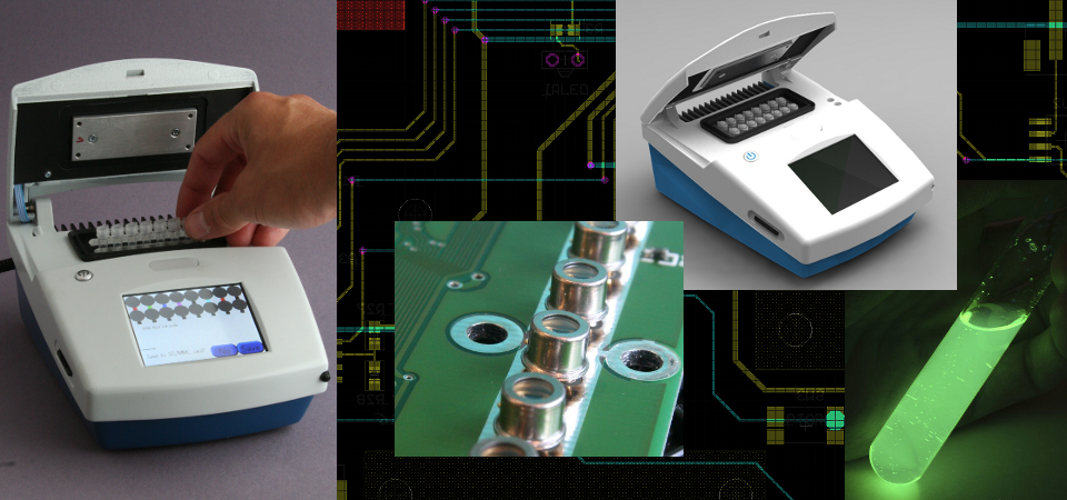
Lumora PDQ microtube luminometer
Lumora’s BART technology produces significantly higher light output than conventional bioluminescent assays and relies on relative rather than absolute light measurements. This combination opens the possibility of simpler, more robust reader architectures than those traditionally used in luminescence instrumentation.
We worked with Lumora to develop a portable, low-cost assay reader suitable for both laboratory and field use, targeting applications including food safety, environmental monitoring, defence and medical diagnostics.
Proof of concept
Conventional luminescence readers rely on photomultiplier tubes (PMTs), which offer high sensitivity at the cost of complexity, fragility and expense. Multi-channel systems often scan a single PMT mechanically across samples, introducing moving parts and limiting robustness.
Our core design decision was to replace the PMT with fixed photodiodes — one per channel — eliminating mechanical scanning and reducing cost and complexity. The critical question was whether a photodiode-based system would provide sufficient sensitivity for BART assays. Initial proof-of-concept experiments confirmed that this approach was viable.
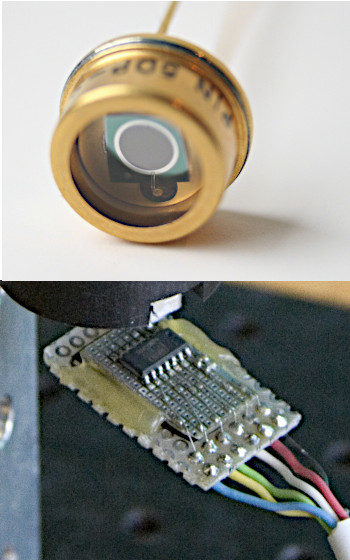
Breadboard – system feasibility
To validate system-level feasibility, we built a breadboard capable of running two complete BART assay in parallel. The system incorporated temperature control at approximately 55 °C and a custom-designed low-noise detector board, operating at photocurrent levels in the picoampere range.
The breadboard demonstrated that a fixed, multi-channel photodiode architecture could deliver stable and usable measurement data, confirming the practicality of the approach.
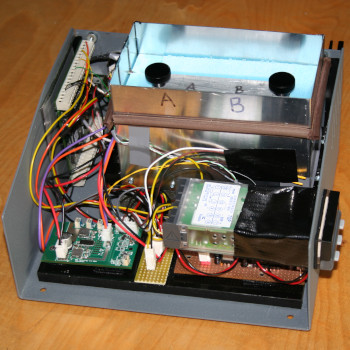
Lab model – from feasibility to usability
Building on the breadboard results, we designed and built a self-contained 8-channel laboratory instrument that no longer required connection to a PC. The system integrated measurement, control and user interface into a single enclosure with a colour touch display.
This lab model was used extensively to run assays across multiple sites and environments, and was demonstrated to prospective partners.
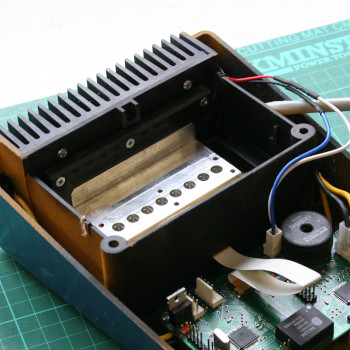
Demonstrator – partner evaluation
Iterative refinement of the lab model focused on robustness, ease of use and repeatability, resulting in a reliable platform for sustained use. This formed the basis for a series of 16-channel product demonstrators, produced for evaluation by commercialisation partners. These systems retained the core architecture while supporting higher throughput, increased reliability and easier firmware customisation. Several demonstrators remained in active use for multiple years.
Commercialisation
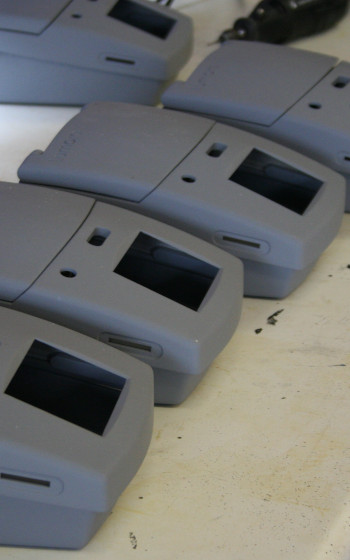
Lumora pursued commercialisation through partners. The PDQ design was manufactured and marketed largely unchanged by Biogal Galed for veterinary applications, while a 96-channel variant capable of reading a full microtitre plate was commercialised by 3M.
Lumora was later acquired by Erba Diagnostics and since operates as Erba Molecular.
Building on the same architectural principles, and in response to renewed demand from Biogal Galed, we are currently developing the Qube4 luminometer as an updated reader platform. More about this here.